Kidai for October — Migrant birds (渡り鳥Watari-tori)

birds

As winter season is approaching, many species of migrant birds are either flying in or flying away from their seasonal habitats.  Some are to the warmer south and some are returning to the cold.

In Japan, in Haiku, Migrant birds (Watari-tori) are mainly ducks and various small birds.   In Maui we start observing flocks of egrets flying in from nowhere and around the sugarcane fields.      Against the emerald sea, the sky and the green sugarcane fields, egrets look very white and they look almost unreal.    When they fly they stretch their grey colored legs straight behind them.   It make me smile when I see some of them are bow-legged.   Many years ago, when I was in Afghanistan I saw a flock of cranes flying over the Himalayan mountains. The contrast of snow capped mountains and cranes’ great wings with their bright red crowns was breathtaking.  I was not sure if those birds came from Japan or not, but watching them, I never felt so far away from home.    As of December, 2016, Hawaii ceased its entire sugar cane production.    Without sugarcane fields where egrets used to find food in winter, their destinations will have to be altered.

鳥帰るいづこの空もさびしからむに  安住敦 

(Tori kaeru izuko-no sora-mo sabishi karamu-ni     Azumi  Atsushi)

The birds are leaving

Where ever they are heading to

There’ll be but lonely skies

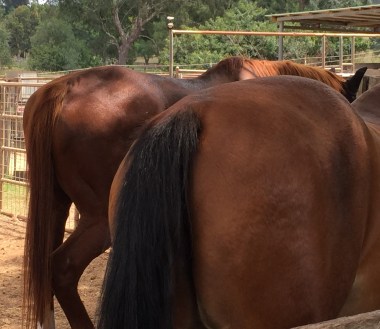
“Fat Horses” and “ Great Appetite” are also Kidai for autumn.


Autumn is the season of harvest.  Everybody enjoy the pleasure of being epicureans, including horses.  Kidai are the concentrated list of century old peoples’ experiences.     Many books have been written about the inner joy of making Haiku.  Among them,        Horin Matsuhisa is a Japan’s leading wood sculptors, specialized in Buddha’s image.  Many of his work are appointed as cultural asset of Japan.  One of his Haiku tell us what is the true attitude of making Haiku.

That Haiku reads:

木の中の仏迎へる鑿の技    朋琳                                                                                (Ki-no naka-no  hotoke mukaeru nomi-no waza)

from the deep of wood                                                                                                                    I welcome Buddha himself                                                                                                              for the art of chisel                         Horin

According to him, the image of Buddha is already existing in my selected wood (natural material).     An artist’s work is only to chisel them off the outer waste.    Michael Angelo must seen the image of his art in the natural mass of marbles even before he set his first chisel.

Pumpkin and Halloween (Kidai)

PKPharvest
pumpkin patch, Kula

The observance of “Halloween” is one of the biggest fun events especially for children and “Pumpkin” is an autumn Kidai, too.

In Japan, people celebrate the harvest season in the different ways, so that many  Pumpkin-Ku tend to be limited only to cooking and eating.

But we found a different kind of Pumpkin Ku by Issa (1763-1828):

鶺鴒が叩いてみたる南瓜かな       一茶
(seki-rei ga tataite mitaru kabocha-kana   Issa)

a Wagtail has
tested the tone
of pumpkin
       (translations)

Note:  October Kukai on the 18th (Wed).   Submission of Ku by the 15th.


“fat horses” and “great appetite” are also Kidai for autumn

IMG_3825Horses Asses - Copy

Autumn is the season of harvest.  Everybody enjoys the pleasure of being epicureans, including horses.  Kidai is the centuries old list of peoples’ experiences.

Many books have been written about the inner joy of making Haiku.  Among them,        Horin Matsuhisa is one of Japan’s leading wood sculptors, specializing in the Buddha’s image.  Many of his works are appointed as cultural assset of Japan.                                  One of his Haiku tell us what is the true “way” of making Haiku.

木の中の仏迎へる鑿の技    朋琳                                                                              (Ki-no naka-no  hotoke mukaeru nomi-no waza)

from the deep of wood                                                                                                                        I welcome Buddha himself                                                                                                             for the art of chisel                         Horin


According to him, the image of the Buddha is already exists in any selected piece of wood (natural material).     An artist’s work is only to chisel off the outer waste.    Michael Angelo must have seen the image of his art in the natural mass of marbles even before he set to it his first chisel also.   He said “I saw the angel in the stone and I carved until I set him free”.


Image

October – the month of autumn

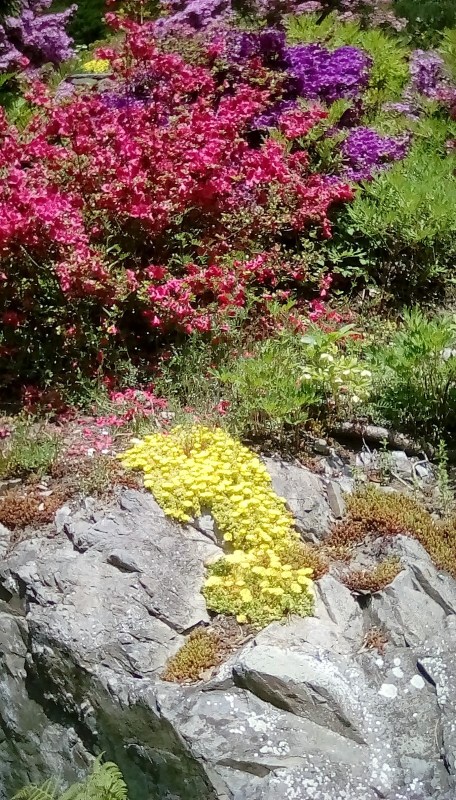
It’s the first day of October today.    Here, I send you wild flowers for you .

October, in Haiku world, it is the last month of autumn yet it is one of the most colorful months of all seasons.   It’s the golden harvest season, leaves are changing colors, wild flowers galore and migrant birds are coming (or going).  In old lunar calendar of Japan, it is called “Naga-tsuki (long month)”, that means, the month of longer nights (to enjoy beautiful moon).    

Rikyu (152-15910), the most influential Tea Master who perfected the Way of Tea.               Rokyu said:  A tea room must be peaceful and quiet so that only the “sound of wind through pine trees (boiling water for tea)” should be heard, and a single vase of wild flowers to be arranged in the room as if they are in the wild and they should live only a day.  It is the Way to appreciate the moment –  that is, in fact, the essence of Haiku.


Kidai : The Moon (2)

BAMBOO_MOON_4.6                                                        Photo by:  Curt Hodge, HIEM

We talked about an autumn Kidai, the “Moon”.   Let us look at some of the famous masters’ Moon-Ku.

Buson (1716-1784) a Japanese poet and painter of the Edo period. Along with  Bashō and Issa,  Buson is considered among the greatest poets of the Edo Period.

The moon reached its zenith                                                                                                      but she passed on over                                                                                                                    the lonely towns  

月天心貧しき町を通りけり    蕪村                                                                              (Tsuki Tenshin   mazushiki machi-o  tori-keri           Buson)


Issa (1763-1823) a poet and lay Buddhist priest.  Despite a multitude of personal trials, his poetry reflects a childlike simplicity, making liberal use of local dialects and conversational phrases.

The beautiful full moon                                                                                                                    child is crying, begging for take it down                                                                                  for she wants to cuddle it                                Issa                                                                       

名月をとってくれろと泣く子かな      一茶                                                                                   (mei-getsu o   totte kure-ro to naku kokana)

Tosei (1903-1996) Okubo (Takeo) Tosei.   A poet, politician, he was Japan’s first Director of the Maritime Safety after the WWII and co-founder of Japan Traditional Haiku Assn.

Raise up the anchor                                                                                                                         let it drip the drops of                                                                                                                moon-shine

錨揚ぐ月の雫を零しつつ    橙青                                                                                              (Ikari agu   tsuki-no Hikari-o  koboshi-tsutsu          Tosei)           

The moon月 (Kidai for August-October)

CH Crescent
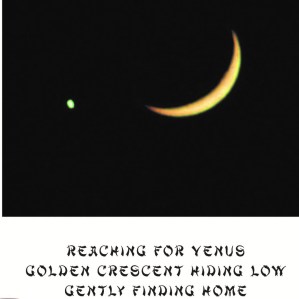
(Photo & Haiku by Curt Hodge/from the book “Healing through Haiku”)

When you use one word, “the Moon”,  in a Ku, it automatically signifies  “Autumn” and it works as Kidai for any month between August and October.   “Moon” is an important Kidai for Haiku and there are many words to specify the moon’s phases.   The lunar calendar starts August 15th and it is the “New Moon” or “No Moon (mu-zuki 無月)” – it is so thin that we cannot see it with our own eyes but it is there.   Counting from the New moon, on the 3rd night,  it is the “crescent moon (Mika-zuki三日月)”.  It is like an ancient royal concubine’s eye brow, they say.  By then the moon rises somewhat later at night, so it is called “sit-and-wait moon (E-machi-zuki居待月).   Then we’re getting slightly inpatient for waiting for the even later moon-rise:  “stand up-and-wait moon (Tachi machi-zuki立待月)”.   By the next night, you are about to give up waiting for the moon, so the night’s moon is called “lie down-and-wait-for moon (Ne-machi- zuki寝待月)”.   By the time when it is called “the 23rd night’s moon” (Niju-san-ya no Tsuki二十三夜の月)  is actually a waning quarter moon, etc, etc., and each has its own mood and inspiration for writing Haiku.

Ancient Hawaiians observed the moon closely and named it with a specific name for each stage of the moon. For example:  Hilo (New moon), Ole Ku Kahi (half-moon), Hoku and Mahealani (full moon), Ole Pau (waning half moon), Muku (No moon), etc.  

Our blog page: Haiku-Mondo.com

IMG_3727

After some of trial and err, finally, we are starting our brand new web page. 

Haiku-Mondo.com

This site is our forum.  Through this page we can keep closer contact to each other .

The title includes a word “Mondo” which is derived from original Japanese Zen word: Mondo (問答)、which means a session of discussion — question and answer.   In modern world it is similar to the word “FAQ”…. And, of course, Mondo is the  word for the “World” in Spanish and Italian.  That makes this title means:  “the place of discussion about Haiku”, and also a “World of Haiku”.

After all, our HIEM group is now expanding to be an international community.      We deserve this tile (I think).   Please put a “favorite” star-mark on your computer, i-phone, smart phone, i-pad, etc.

Thank you.    Rinko

Ginko 吟行 (Haiku Walk) for inspiration

IMG_20170922_120556IaoBD

A stroll in nature is always inspirational.
Iao Valley State Park is one of the “Must-be-there to inhale” type of scenic points on the island of Maui. Only a few miles from the city center of the island’s capital you will see an erosional feature called Iao “needle” abruptly rising 1200 feet from the valley floor. This was the site of the decisive yet bloody battle in 1790 which King Kamehameha won and thereby unite all islands. As such, this valley contains historical and spiritual values. It’s a good Ginko (Haiku walk) place and HIEM had a few good Haiku meetings there.
The photo copy of “Iao Valley” is one of the HIEM
Members by his unique technique of painting that he calls “candle flame painting”. He uses this method for his own Haiga (painting with Haiky).
It reads:

The eyes wide open…
            Transfixed by Nature’s Oneness…
                         How green this Valley

by Bryan: burningdebrismaui@yahoo.com

Let us send “Get well Soon” Ku to Jody

Kukai Jody2_3621 (#4)
Jody Wyatt

One of our favorite poets, Jody Wyatt, who recently won the Haiku International Association Award at the Japan’s 28th “Ito-en New Haiku Contest” by her Ku:     

The proud rooster
Ignores the rain
He shines with his own light

(at the first day of the Year of the rooster     Jody Wyatt, HIEM)

Jody has taken ill (cardiac) in the Washington State while she was visiting her family.  Luckily, she is now on her way to recovering.

A genre of Haiku “Greeting-Ku (挨拶句・Aisatsu-ku)” is one of the important aspects of Haiku and to send Greeting Ku in many occasions has become one of our traditions.

Please send in a heart felt Ku of  dedication to Jody.   I’ll pass it on to her by post. (she is not accessible by internet)