
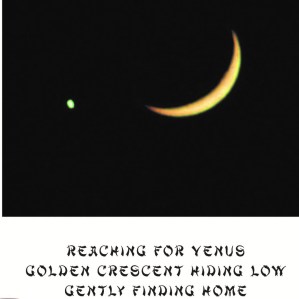
(Photo & Haiku by Curt Hodge/from the book “Healing through Haiku”)
When you use one word, “the Moon”, in a Ku, it automatically signifies “Autumn” and it works as Kidai for any month between August and October. “Moon” is an important Kidai for Haiku and there are many words to specify the moon’s phases. The lunar calendar starts August 15th and it is the “New Moon” or “No Moon (mu-zuki 無月)” – it is so thin that we cannot see it with our own eyes but it is there. Counting from the New moon, on the 3rd night, it is the “crescent moon (Mika-zuki三日月)”. It is like an ancient royal concubine’s eye brow, they say. By then the moon rises somewhat later at night, so it is called “sit-and-wait moon (E-machi-zuki居待月). Then we’re getting slightly inpatient for waiting for the even later moon-rise: “stand up-and-wait moon (Tachi machi-zuki立待月)”. By the next night, you are about to give up waiting for the moon, so the night’s moon is called “lie down-and-wait-for moon (Ne-machi- zuki寝待月)”. By the time when it is called “the 23rd night’s moon” (Niju-san-ya no Tsuki二十三夜の月) is actually a waning quarter moon, etc, etc., and each has its own mood and inspiration for writing Haiku.
Ancient Hawaiians observed the moon closely and named it with a specific name for each stage of the moon. For example: Hilo (New moon), Ole Ku Kahi (half-moon), Hoku and Mahealani (full moon), Ole Pau (waning half moon), Muku (No moon), etc.
 haiku-mondo.com